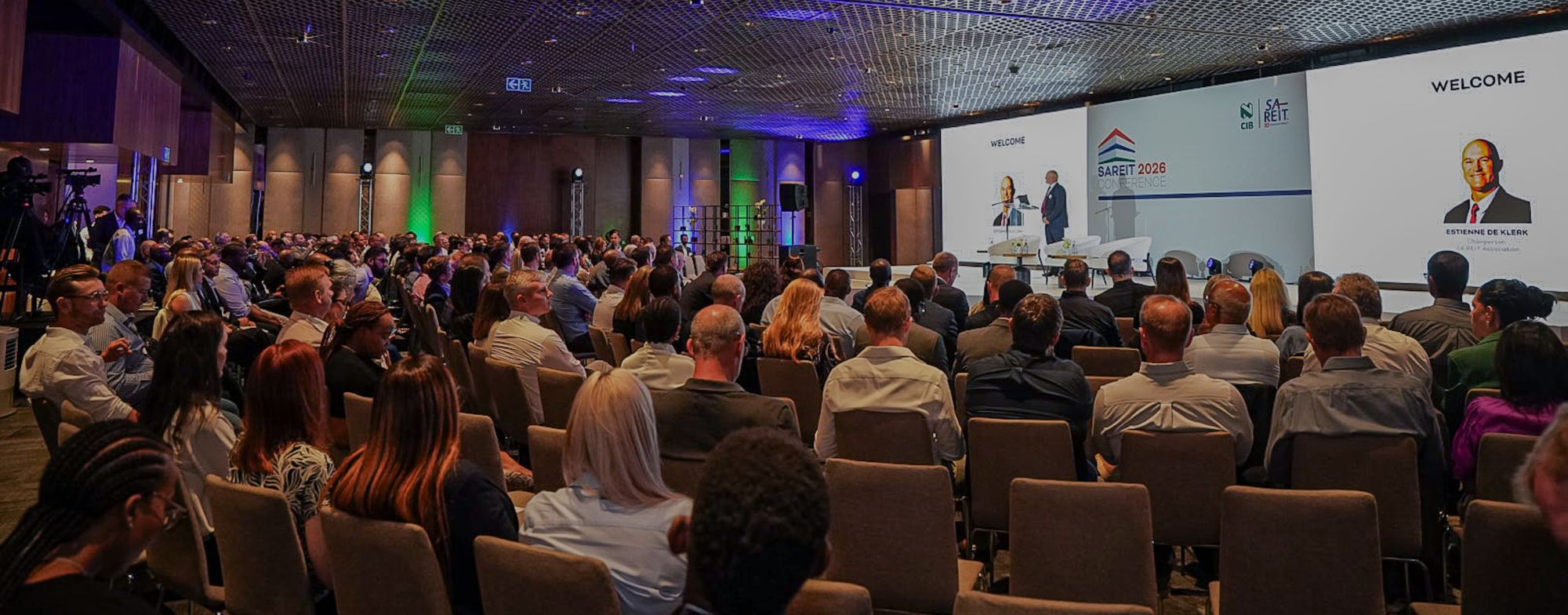
Inside the sold-out SA REIT Conference
Global shockwaves, local momentum: Inside the sold-out SA REIT Conference
A month on from the sector’s marquee gathering, the message is clear: South African REITs have shifted from survival mode to strategic growth. And the world is watching.
When the SA REIT Association convened its annual conference on 12 February 2026 at The Venue, Houghton Hotel in Johannesburg, every seat was taken. The sold-out event, proudly sponsored by Nedbank Corporate and Investment Banking’s Property Finance Division, drew the full spectrum of listed property decision-makers. Master of Ceremonies Michael Avery set the day’s tone early: This was a sector with its confidence back.
A month later, that confidence has been validated. According to the latest SA REIT Association Chart Book for February 2026, compiled by Ian Anderson, Portfolio Manager at Merchant West Investments, the sector surged 8.1% in February alone, pushing total market capitalisation past R350 billion for the first time. Year-to-date returns stand at 9.1% and distribution growth across the sector is running at 8.06% on a rolling 12-month basis.
The conference programme, opened by SA REIT Association Chairman Estienne de Klerk, spanned macroeconomics, regulatory reform, investor sentiment, global REIT dynamics and the political landscape ahead of the 2026 local elections. Here are the key themes that emerged.
A world through the looking glass
Prof Adrian Saville, Founding Director of Boundless World, opened with a sweeping assessment titled “Global Shockwaves, Local Crossroads.” Drawing on Lewis Carroll’s Through the Looking-Glass, Saville framed 2026 as a year in which familiar rules have been rewritten. “The real question is how do we prepare to thrive in a world that has stepped through a looking glass,” he told delegates.
Amid the volatility, Saville identified three constants. First, business drivers remain unchanged: real GDP growth continues to correlate tightly with corporate revenue and earnings. Second, the fundamental growth drivers of nations – savings and investment, demography, policy quality, education, health and openness – are powering a dramatic eastward shift in global economic gravity, with BRICS now accounting for 36.2% of global GDP on a purchasing power parity basis, overtaking the G7 at 29.1%. Third, sources of competitive advantage are resilient: Businesses that combine agility with deep shock-absorbing capacity consistently outperform.
On South Africa, Saville’s assessment was nuanced. Two further rate cuts were expected in 2026, before the USA/Israel/Iran war muddied the waters, inflation is low and stable, and the rand was trading lower against USD. Progress on grey list removal, Eskom stabilisation and Vulindlela reforms is tangible. Yet growth remains below population growth, youth unemployment and inequality are entrenched and manufacturing’s share of GDP has fallen from 22% in 1980 to just 11.2% by 2024.
Clearing the roadblocks: The B4SA reform agenda
Martin Kingston, Executive Chairman of Rothschild & Co South Africa and Chair of the B4SA Steering Committee, delivered a detailed reform progress report. Approximately 160 CEOs from companies with a combined market capitalisation exceeding R11 trillion have committed to addressing the country’s structural challenges across energy, transport, crime and youth employment.
On energy, loadshedding days have plunged 98% from 290 in 2023 to just seven in 2025. Eskom’s energy availability factor improved from 56.6% to 63.5% and six gigawatts of new generation capacity came online. In transport, Transnet freight rail volumes are forecast to reach 171 million tonnes in FY25/26, up from 149 million tonnes two years earlier, with 11 new rail operators licensed. On crime and corruption, all 40 FATF recommendations have been completed and more than 500 officials trained in financial forensics. Business has donated over R180 million via the Resource Mobilisation Fund.
Kingston reserved urgency for Johannesburg, describing a city in decline with minimal capital expenditure, growing debt, entrenched corruption and the spectre of “Day Zero” service delivery failures. For property investors, the implications are direct: escalating rates and taxes and decreasing property values. He argued that Johannesburg is critical to the broader “SA Inc” narrative and that urgent national government intervention is required.
From headwinds to renewed momentum: The investor verdict
Independent property analyst Keillen Ndlovu delivered one of the conference’s most anticipated sessions, presenting his annual survey of 25 fund selectors. The headline finding was emphatic: in 2024, 48% of fund managers were underweight on the sector and only 12% were overweight. By early 2026, those positions had reversed. Just 12% remain underweight, while 40% are now overweight or neutral-to-overweight.
SA listed property delivered a total return of 30.6% in 2025, with 2024 having produced 29.8%. Prices have recovered above pre-COVID levels, though they remain below the 2017 peak. Critically, the 2026 earnings outlook is positive across virtually the entire sector: Heriot is guiding 10% to 15% growth, Hyprop 10% to 12%, Resilient above 10% and Vukile above 9%. Balance sheets have strengthened with falling loan-to-value ratios and rising interest cover. The sector raised over R11 billion in fresh equity during 2025 through oversubscribed bookbuilds, while listed property’s allocation in balanced funds has recovered to 4.2%, surpassing pre-pandemic levels.
“If you drive around Sandton and Rosebank today, the cranes are back,” Ndlovu observed. “The physical economy is matching the REIT sector’s recovery.”
Deal activity has been prolific. Ndlovu highlighted a string of transactions already in early 2026, from Discovery’s R4.05 billion acquisition of its Sandton headquarters to Vukile’s R5.2 billion Spanish retail parks deal, the GEPF’s R1.8 billion Century City purchase and Growthpoint’s disposal of its 55% share in Discovery Phase 1 for R2.32 billion. These moves reflect a sector where capital allocation is becoming increasingly strategic.
Among structural developments, the FTSE/JSE All Property Index is expanding from 23 March 2026 to include more stocks. In early March, the JSE confirmed the inclusion of Spear REIT, Dipula Properties and Octodec Investments in both the ALPI and the SA REIT Index, a development welcomed by the SA REIT Association as broadening the benchmark and reinforcing the depth of the sector.
Ndlovu also noted that Central and Eastern Europe and Iberia now play a major role in the local sector, with companies such as NEPI Rockcastle, Lighthouse Properties and Vukile deriving significant portfolio exposure from these regions. Looking forward, he identified multifamily residential, healthcare and student accommodation as the most likely new property sectors to list on the JSE. Sell-side analysts forecast total shareholder returns of 8.6% to 18% for 2026, with no sell recommendations.
South Africa: A global REIT world-beater
Peter Verwer, Executive Chairman of Futurefy, provided the international perspective, declaring that the world is entering a “REITs 4.0” era characterised by an expanding universe of property sectors, a truly global franchise and the use of REITs as strategic nation-building instruments.
Verwer positioned South Africa as a standout. Over the five years to January 2026, SA REITs delivered a 21% annualised total return in local currency, outperforming the United States (7.6%), Australia (8.4%), Japan (5.8%) and the United Kingdom (0.6%). South Africa’s REIT market capitalisation as a proportion of total commercial real estate value stands at 19%, second globally only to Singapore.
Globally, listed REITs have grown from 120 in 1990 to more than 1,000 by 2024, with traditional property types now comprising only 40% of the global index – healthcare, telecommunications, data centres and specialised sub-sectors make up the rest. Verwer argued that governments increasingly view REITs as infrastructure delivery tools. He cited case studies from India, Singapore and Mauritius and urged South Africa to leverage REITs as “nation-building apps” capable of supporting urbanisation and infrastructure delivery without burdening public debt.
The 2026 elections and the city-state imperative
Political analyst Dr Ralph Mathekga delivered a frank assessment of local government ahead of the 2026 municipal elections. His message was blunt:The threat of local government collapse is real, and South Africa’s democracy cannot be sustained without a functional local space.
Mathekga warned of deepening political fragmentation at the municipal level, with coalition dynamics delaying decision-making. Yet he framed this as part of a necessary evolution, with power decentralising away from national politics. His most arresting insight was his advocacy for a “city-state” model: “It matters more who is the mayor of your city than who is the president of your country,” he argued – a statement that resonated deeply with property professionals whose asset values are tied to municipal competence.
Momentum confirmed, vigilance required
The sold-out SA REIT Conference 2026 captured a sector at an inflection point. After years of headwinds, South African REITs have delivered two consecutive years of exceptional returns, seen their total market capitalisation breach R350 billion and are guiding for distribution growth well above inflation. Institutional investors are returning in force, capital markets are open and deal activity is robust. Internationally, as Verwer demonstrated, South African REITs are genuine world-beaters and the global REIT franchise continues to expand into new frontiers that present significant opportunity for this market.
Yet the conference’s most valuable contribution was its refusal to allow the good news to obscure the structural risks. Saville’s reminder that growth still lags population growth, Kingston’s warnings about Johannesburg, Ndlovu’s observation that even underweight managers now concede they got it wrong, and Mathekga’s assessment of local government fragility; these are the markers of a sector thinking honestly about what comes next.
As Anderson noted about the February Chart Book: “Investors will be watching whether improving earnings can justify current valuations as the market transitions from recovery to momentum.” That transition is well under way. The question now is how South Africa’s REITs will sustain it.
About the SA REIT Conference 2026
The SA REIT Conference 2026 was held on 12 February at The Venue, Houghton Hotel, Johannesburg, proudly sponsored by Nedbank Corporate and Investment Banking’s Property Finance Division. The SA REIT Association promotes SA REITs as an investment class both locally and internationally. For more information, visit sareit.co.za.